


Il corso online prodotto da UniPv sulla prevenzione delle Specie Aliene Invasive (IAS) acquatiche attrae iscritti da tutto il mondo
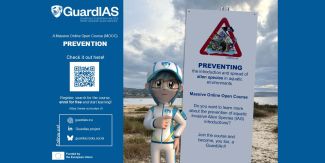
(English below) Il progetto HORIZON GuardIAS, "Guarding European Waters from Invasive Alien Species (IAS)", finanziato dall'UE e di durata triennale, riguarda la grave problematica ambientale delle specie aliene invasive acquatiche, con l'obiettivo di migliorarne la capacità di gestione e prevenirne l’ulteriore diffusione negli habitat marini e d'acqua dolce, utilizzando una serie di metodi innovativi.
Tra le varie finalità, GuardIAS mira anche ad aumentare il trasferimento di conoscenze tra la comunità scientifica e la società. A tal fine, GuardIAS dedica obiettivi e attività specifiche all'istruzione e alla formazione, al coinvolgimento del pubblico e alla sensibilizzazione sull’argomento. I corsi online aperti e gratuiti (dall’inglese, MOOC: Massive Online Open Courses) offrono una forma di istruzione e formazione accessibile e inclusiva, basata sull'apprendimento virtuale e asincrono e, pertanto, sono stati proposti come principale approccio didattico per raggiungere gli scopi di GuardIAS. La realizzazione di cinque MOOC è una delle attività assegnate all'Università di Pavia, che partecipa con un team multidisciplinare composto da personale del Dipartimento di Scienze della Terra e dell’Ambiente e Dipartimento di Studi Umanistici.
In particolare, il Laboratorio di Ecologia del Dipartimento di Scienze della Terra e dell'Ambiente sta conducendo il lavoro di ideazione e realizzazione dei MOOC di GuardIAS, con la collaborazione di colleghi e colleghe dell’Università di Firenze, della Aegean University (Grecia) e del consorzio IECS (The International Estuarine & Coastal Specialists Ltd, UK).
Il primo MOOC, intitolato "Prevenzione delle IAS", è stato rilasciato ai primi di ottobre 2025 ed è disponibile gratuitamente sulla piattaforma ECM UniPv. Questo corso offre un'introduzione completa al problema critico delle bioinvasioni, ed è stato progettato per professionisti, accademici e studenti in settori quali la gestione ambientale, la conservazione della Natura e le Scienze acquatiche. È un'ottima opportunità per approfondire la comprensione e la prima misura per una gestione efficace delle IAS: la prevenzione. Grazie alla collaborazione con l’azienda pavese 4Draw, specializzata in modellazione 3D, realtà aumentata e realtà virtuale, il corso è risultato interattivo e dinamico e costituisce un'opportunità unica per approfondire le conoscenze su un argomento critico per la protezione ambientale e la biosicurezza.
Questo primo MOOC GuardIAS prodotto da UniPv è stato promosso non solo sul sito del progetto, ma è approdato anche sulle newsletter di importanti Centri di Ricerca Europei, come il CSIC - Consejo Superior de Investigaciones Científicas (il CNR spagnolo) o l’INBO - Instituut voor Natuur- en Bosonderzoek (Istituto Belga per la Ricerca Naturale e Forestale).
Con circa 120 iscritti, tra cui molti provenienti dal mondo accademico (studenti o ricercatori), ma anche liberi professionisti o dipendenti di agenzie pubbliche (Province, Regioni e Ministeri), il bilancio del primo mese online è decisamente positivo. Oltre a numerosi partecipanti da tutte le Regioni d’Italia il MOOC ha attratto iscritti da vari Paesi Europei (Spagna, Grecia, Belgio, Lituania, Irlanda,...) ma anche da nazioni remote come Saint Helena, Ascension and Tristan da Cunha, Sri Lanka e Nuova Zelanda.
Il team UniPv è ora impegnato alla realizzazione del secondo dei cinque MOOC previsti entro la fine del progetto GuardIAS, che tratterà il tema del rilevamento precoce e monitoraggio della IAS acquatiche e la cui uscita è prevista tra pochi mesi. I tre restanti MOOC si occuperanno di: previsione e definizione delle priorità per la gestione; eradicazione e controllo delle IAS acquatiche; mitigazione dell'impatto delle IAS sulle specie minacciate.
***
The online course on acquatic invasive alien species (IAS) attracts subscriptions form all over the world
The three-year EU-funded HORIZON GuardIAS project, “Guarding European Waters from Invasive Alien Species (IAS),” addresses the serious environmental issue of invasive alien aquatic species, with the aim of improving management capacity and preventing their further spread in marine and freshwater habitats using a range of innovative methods.
Among its various objectives, GuardIAS also aims to increase knowledge transfer between the scientific community and society. To this end, GuardIAS dedicates specific objectives and activities to education and training, public engagement, and awareness-raising on the topic. FreeMassive Online Open Courses (MOOCs) offer an accessible and inclusive form of education and training based on virtual and asynchronous learning and have therefore been proposed as the main educational approach to achieve the objectives of GuardIAS.
The creation of five MOOCs is one of the activities assigned to University of Pavia, which is participating with a multidisciplinary team composed of staff from the Department of Earth and Environmental Sciences and the Department of Humanities.
In particular, the Ecology Laboratory of the Department of Earth and Environmental Sciences is leading the design and implementation of GuardIAS MOOCs, in collaboration with colleagues from the University of Florence and Aegean University (Greece) and the IECS consortium (The International Estuarine & Coastal Specialists Ltd, UK).
The first MOOC, entitled “IAS Prevention,” was released in early October 2025 and is available free of charge on the ECM UniPv platform. This course offers a comprehensive introduction to the critical issue of bioinvasions and is designed for professionals, academics, and students in fields such as environmental management, nature conservation, and aquatic sciences. It is an excellent opportunity to deepen understanding and learn about the first step towards effective IAS management: prevention. Thanks to the collaboration with the Pavia-based company 4Draw, which specializes in 3D modeling, augmented reality, and virtual reality, the course is interactive and dynamic and provides a unique opportunity to deepen knowledge on a critical topic for environmental protection and biosecurity.
This first GuardIAS MOOC produced by UniPv was promoted not only on the project website, but also in the newsletters of important European research centers, such as the CSIC - Consejo Superior de Investigaciones Científicas (the Spanish Spanish National Research Council) and the INBO - Instituut voor Natuur- en Bosonderzoek (Belgian Institute for Nature and Forest Research).
With around 120 participants, including many from the academic world (students or researchers), but also freelancers or employees of public agencies (provinces, regions, and ministries), the results of the first month online are definitely positive. In addition to numerous participants from all regions of Italy, the MOOC has enrolled people from various European countries (Spain, Greece, Belgium, Lithuania, Ireland, etc.) as well as from more distant countries such as Saint Helena, Ascension and Tristan da Cunha, Sri Lanka, and New Zealand.
The UniPv team is now working on the second of five MOOCs planned for completion by the end of the GuardIAS project, which will deal with the early detection and monitoring of aquatic IAS and is scheduled for release in a few months. The remaining three MOOCs will deal with: IAS prioritization for management; eradication and control; impacts mitigation.
Image: Background picture from a CHEbro sign in Arija, Ebro Reservoir, for dissemination purposes on alien species. Sign content has been modified.